
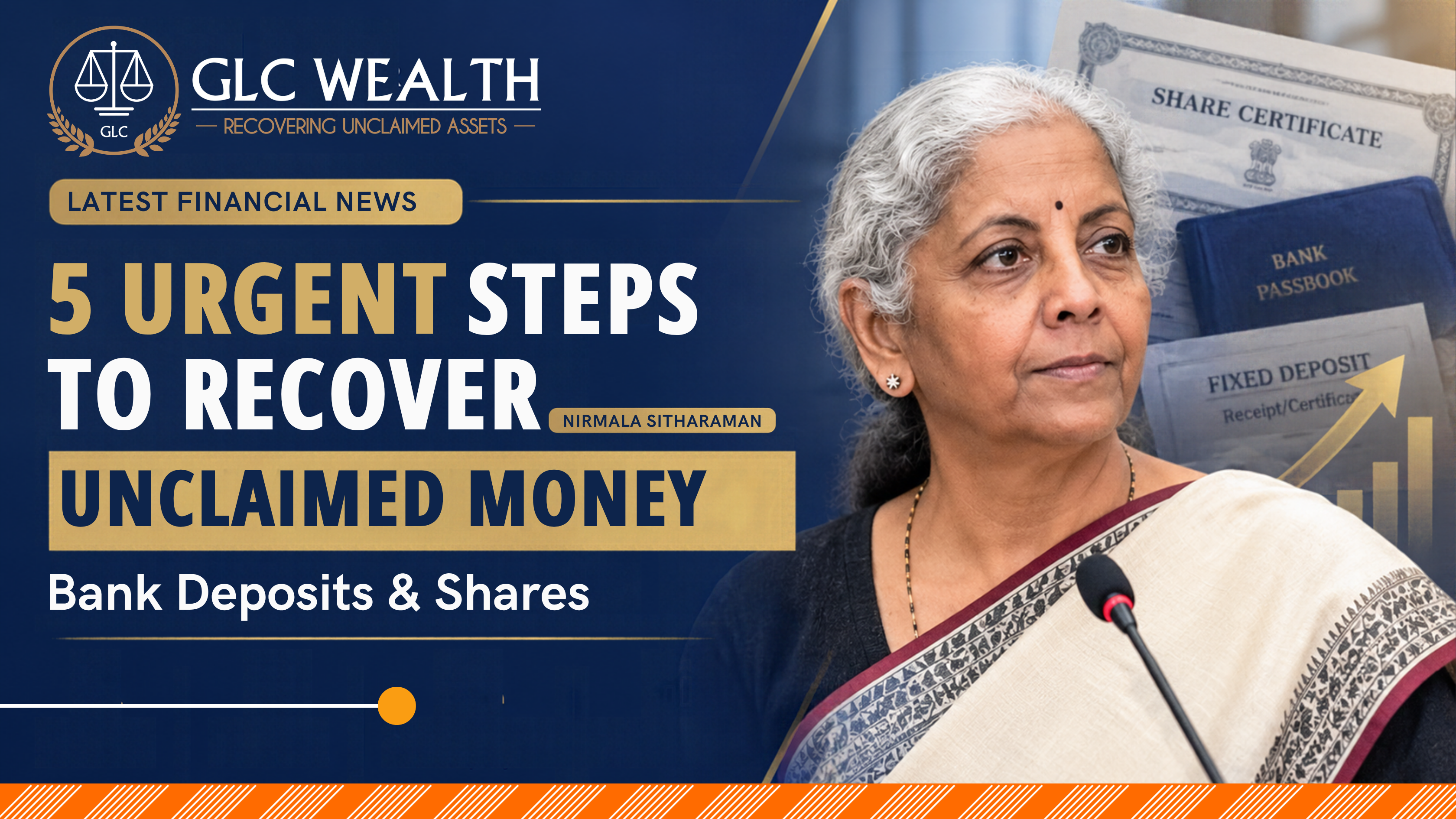
Nirmala Sitharaman Urges Faster Refunds of Unclaimed Money: 5 Steps to Recover Your Bank Deposits and Shares in 2026
Unclaimed Money in India
is receiving renewed attention after Finance Minister Nirmala Sitharaman urged regulators to speed up refunds of unclaimed bank deposits, shares, dividends and other financial assets. This announcement highlights the importance of helping investors, senior citizens, NRIs and families recover money that may have remained forgotten for years.
Whether you have old physical share certificates, an inactive bank account or investments belonging to a deceased family member, understanding the recovery process is the first step towards claiming eligible assets.
Bringing renewed attention to this issue, Union Finance Minister Nirmala Sitharaman urged financial regulators and other stakeholders to speed up refunds of unclaimed financial assets to their rightful owners on October 23, 2026.
According to a report published by Hindustan Times, the issue was discussed at the 30th meeting of the Financial Stability and Development Council (FSDC), chaired by the Finance Minister in New Delhi.
The announcement covered several categories of unclaimed assets, including bank deposits, dividends, shares, post office accounts, insurance and pension funds. The Council also encouraged further efforts under the government’s Your Money, Your Right campaign to help people reclaim their money.
For investors, senior citizens, NRIs and families managing inherited wealth, this development is an important reminder to identify forgotten investments and understand the procedures required to recover them.

In this article, we explain what the latest announcement means, which assets you should check and how you can begin the recovery process.
What Did Nirmala Sitharaman Announce on Unclaimed Financial Assets?
At the FSDC meeting held on October 23, 2026, Finance Minister Nirmala Sitharaman urged regulators and concerned stakeholders to expedite the refund of unclaimed financial assets to their rightful owners.
The assets discussed included:
- Unclaimed bank deposits and fixed deposits
- Unclaimed shares and dividends
- Money held in post office accounts
- Unclaimed insurance benefits
- Unclaimed pension funds and related benefits
The Council took note of efforts undertaken under the Your Money, Your Right campaign and encouraged ministries and regulators to continue working towards timely refunds.
The FSDC meeting also discussed simplifying and digitising Know Your Customer (KYC) processes, including digital onboarding for Non-Resident Indians (NRIs) and Foreign Portfolio Investors (FPIs).
What does this mean for investors? The announcement reinforces the importance of making it easier for rightful owners to identify and claim forgotten financial assets. However, it should not be interpreted as an automatic refund scheme or a guarantee of immediate recovery. Existing eligibility conditions, documentation requirements and verification procedures continue to apply.
1. Unclaimed Bank Deposits: Check Forgotten Savings Accounts and Fixed Deposits
Bank accounts and fixed deposits can remain unclaimed when account holders stop using them, move to another city or country, or forget to update their contact details.
Under applicable RBI rules, deposits that remain unclaimed or inoperative for 10 years are generally transferred by banks to the Depositor Education and Awareness (DEA) Fund.
However, eligible depositors and legal heirs can still claim the money through the relevant bank’s prescribed procedure.
How to Find and Recover Unclaimed Bank Deposits
- Identify the bank where the account or fixed deposit was maintained.
- Use the RBI’s UDGAM portal to search for eligible unclaimed deposits across participating banks.
- Collect available records, including old passbooks, deposit receipts and account details.
- Contact the concerned bank and request its claim procedure.
- Submit the required identity, ownership and succession documents, where applicable.
For official information, visit the RBI UDGAM portal.
The exact procedure depends on the bank, the status of the deposit and whether the original account holder is alive or deceased.
2. Unclaimed Shares and Dividends: Your Old Investments May Still Have Value
Many investors purchased shares decades ago and subsequently lost track of their investments. Others may still have physical share certificates stored in cupboards, lockers or old family files.
Changes in address, missing documents, outdated bank details and the death of an investor can make it difficult to receive dividends or manage investments.
Under the applicable provisions of the Companies Act, shares are generally transferred to the Investor Education and Protection Fund (IEPF) when dividends remain unpaid or unclaimed for seven consecutive years, subject to the statutory requirements.
Importantly, the transfer of eligible shares to IEPF does not automatically eliminate the rightful owner’s ability to claim them.
What Should You Check?
- Old physical share certificates
- Company names and shareholder details
- Folio numbers and certificate numbers
- Old dividend warrants or dividend statements
- Previous investment records and demat statements
- Documents belonging to deceased parents or grandparents
Even if the original share certificates are missing, available records may help establish the investment and determine the appropriate recovery procedure.
3. How to Recover Shares Transferred to IEPF
If your shares or dividends have been transferred to IEPF, you generally need to identify the investment, establish your entitlement and complete the prescribed claim process.
Step 1: Identify the Original Investment
Find the name of the company, shareholder details, folio number and any available certificate or dividend information.
Step 2: Verify the Current Status
Check with the company or its Registrar and Transfer Agent (RTA) to determine whether the shares and dividends remain with the company or have been transferred to IEPF.
Step 3: Prepare the Required Documents
Depending on the case, you may need PAN, identity and address proof, bank details, a Client Master List (CML), supporting investment records and applicable declarations.
Claims involving deceased investors may require additional succession and transmission documents.
Step 4: Submit the Claim
File the applicable claim using the prescribed IEPF process and provide the required documents to the company or relevant authority.
Step 5: Complete Verification
The company and the relevant authorities verify the claim before eligible shares or amounts can be returned.
For official information, visit the Investor Education and Protection Fund Authority website.
4. Post Office, Insurance and Pension Funds: Do Not Ignore Other Financial Assets
The Finance Minister’s announcement also covered unclaimed post office accounts, insurance and pension-related funds. These assets are often overlooked because families may not know which institution holds them.
Post Office Accounts
Review old post office savings account records, deposit receipts and other available documents. Contact the relevant post office or designated authority to determine the account status and applicable claim procedure.
Insurance Benefits
Check old insurance policies, policy numbers, premium receipts and records of policies held by deceased family members. Contact the insurer to verify whether any maturity proceeds, death benefits or other amounts remain payable.
Pension Benefits
Review pension records, payment statements and documents related to eligible pension benefits. Contact the relevant pension authority or provider to confirm whether any amount remains unpaid or unclaimed.
Each category has its own eligibility conditions, verification requirements and claim procedures. The relevant institution should confirm the steps applicable to your case.
5. Recovering Investments After the Death of a Family Member
One of the most challenging situations arises when financial assets belong to a deceased parent, grandparent or other relative.
Families may discover old share certificates, forgotten bank deposits or dividend records years after the original investor’s death. In some cases, they may not even know which companies or financial institutions held the assets.
The recovery process may require proof of the original investor’s ownership as well as documents establishing the claimant’s entitlement.
Documents That May Be Required
- Death certificate of the original investor
- PAN and identity documents of the claimant
- Proof of relationship or legal-heir documentation
- Nomination details, if available
- Original share certificates or other investment records, where applicable
- Transmission forms and supporting declarations
- Succession certificate, probate or other legal documents, where required
The exact requirements depend on the nature of the asset, the institution’s rules, the presence of a nominee and the circumstances of the estate.
Families should avoid assuming that a nominee and a legal heir always have identical rights or responsibilities. Where succession issues are complex, appropriate legal guidance may be necessary.
What Is the Your Money, Your Right Campaign?
The Your Money, Your Right campaign aims to help people identify and reclaim unclaimed financial assets. It brings attention to the need for coordination among financial institutions, regulators and government authorities so that eligible claimants can access money that belongs to them.
At its October 23, 2026 meeting, the FSDC acknowledged the work undertaken by stakeholders at the district level and encouraged ministries and regulators to pursue additional efforts to ensure timely refunds to rightful owners.
For individuals and families, the practical takeaway is to review financial records, identify potentially unclaimed assets and approach the appropriate institution with the necessary documents.
The campaign’s continued implementation does not remove the need to satisfy the existing legal and procedural requirements for each claim.
Official source: Press Information Bureau – 30th Meeting of the Financial Stability and Development Council.
How GLC Wealth Advisor Can Help With Unclaimed Shares and Investments
Tracing forgotten financial assets can require detailed research, document verification and coordination with companies, registrars and other institutions.
GLC Wealth Advisor assists investors and families with unclaimed share and investment recovery matters, including physical share assistance, lost share recovery, share transmission, unclaimed dividend recovery and eligible IEPF claims.
Our assistance may include:
- Tracing old shareholdings and investment records
- Identifying companies and relevant folio details
- Assisting with lost or damaged share certificate cases
- Supporting the share transmission process after an investor’s death
- Helping organise documents for eligible IEPF claims
- Assisting with unclaimed dividend recovery procedures
Each case is assessed according to the available records, applicable regulations and the requirements of the concerned institution. Recovery is not guaranteed, and final approval rests with the relevant authorities or institutions.
Frequently Asked Questions
1. What did Nirmala Sitharaman say about unclaimed money in October 2026?
On October 23, 2026, Finance Minister Nirmala Sitharaman urged financial regulators and other stakeholders to speed up refunds of unclaimed bank deposits, dividends, shares, post office accounts, insurance and pension funds to their rightful owners.
2. Can I recover bank deposits that have remained unclaimed for 10 years?
Eligible depositors and legal heirs can generally claim such deposits through the relevant bank’s prescribed procedure, even after the funds have been transferred to the DEA Fund. The claimant must meet the applicable requirements.
3. Can I recover shares transferred to IEPF?
Eligible claimants can apply for the return of shares and dividends transferred to IEPF by following the prescribed claim and verification process.
4. Can I recover shares belonging to my deceased parents?
Recovery may be possible if you establish the original investor’s ownership and your entitlement to the assets. The required documents depend on the circumstances and the relevant institution’s rules.
5. Does the latest announcement guarantee faster refunds for everyone?
No. The announcement calls for regulators and stakeholders to expedite the refund process. It does not guarantee an immediate refund, a fixed processing time or approval of every claim.
Conclusion
The October 23, 2026 announcement by Finance Minister Nirmala Sitharaman highlights the importance of returning unclaimed financial assets to their rightful owners.
From forgotten bank deposits and old physical share certificates to unclaimed dividends, post office accounts, insurance and pension benefits, families may have financial assets that deserve a closer review.
The first step is to identify where the asset is held. The next is to understand the applicable claim process, gather the necessary documents and complete verification with the relevant institution.
If you have old share certificates, forgotten investments or shares belonging to a deceased family member, reviewing the available records can help you determine the appropriate next steps.
Looking to trace and recover unclaimed shares or investments?
Contact GLC Wealth Advisor for assistance with eligible unclaimed share and investment recovery matters.
Website: www.glcwealth.com
Email: [email protected]
Phone: +91 93103 03046
Disclaimer: This article is intended for general informational purposes only and does not constitute legal, tax or investment advice. Procedures, eligibility, documentation and processing times may vary depending on the asset and the applicable rules. Please verify current requirements with the relevant bank, company, RTA, insurer, pension authority or government body.