6 Powerful Steps to Recover Old Physical Share Certificates in India
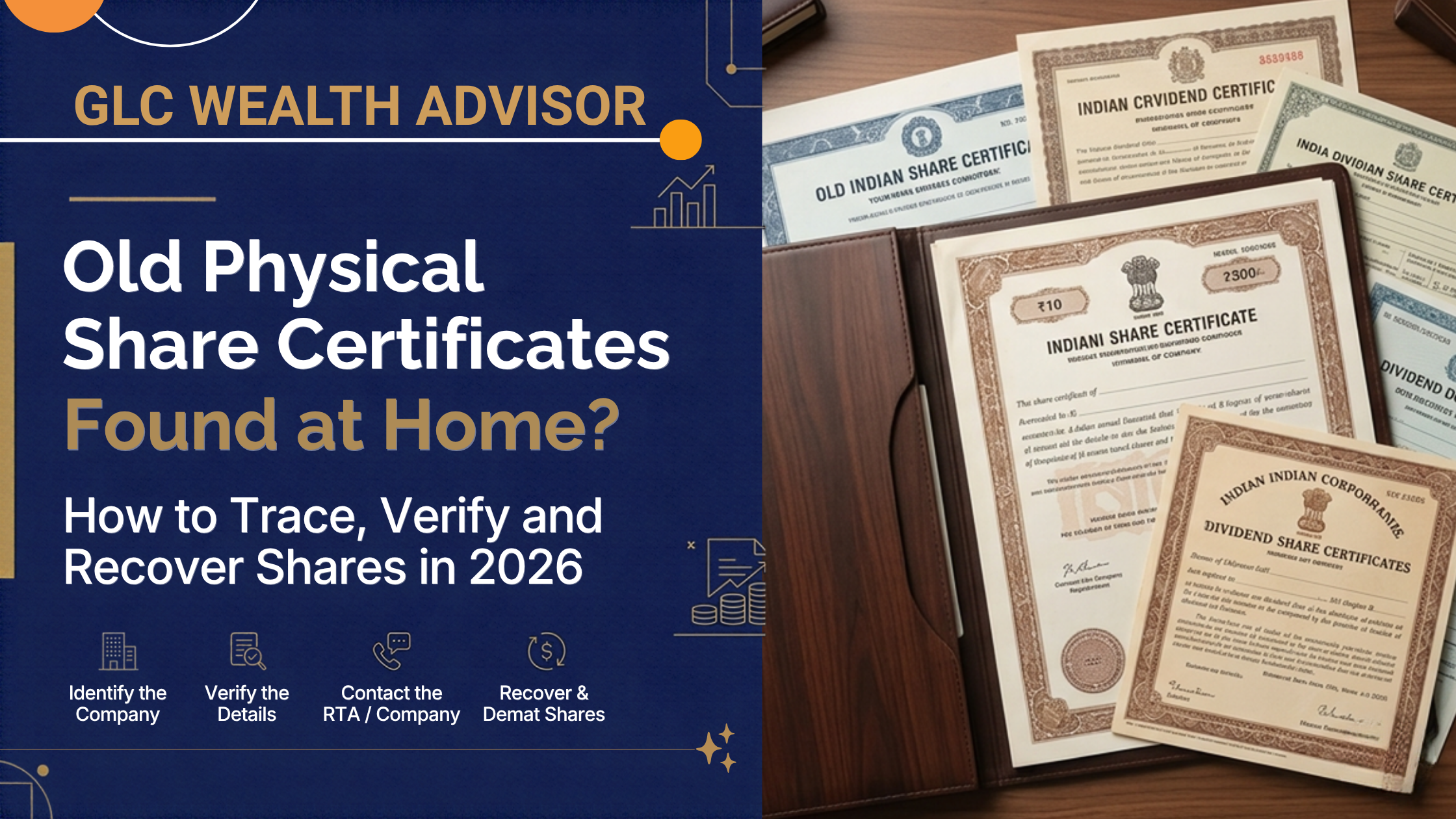
Old Physical Share Certificates Found at Home? How to Trace, Verify and Recover Shares in 2026
While cleaning an old cupboard, organising financial documents or sorting through a family locker, you may come across physical share certificates issued many years ago. They might belong to you, your parents or another family member who invested in Indian companies decades ago.
At first glance, these certificates may look outdated or insignificant. You might wonder whether the company still exists, whether the shares have any value or whether the documents can still be used to claim the investment.
The important thing to know is that an old physical share certificate should not be dismissed without verification. The investment may still be traceable, even if the certificate is damaged, the company has changed its name or the original shareholder has passed away.
However, finding a certificate does not automatically establish that the shares remain active or can be transferred immediately. Their current status, ownership records, corporate actions and applicable regulatory requirements must be checked.
In this guide, we explain how to trace old physical share certificates, verify their status and understand the steps involved in recovering eligible shares in India in 2026.
1. What Are Old Physical Share Certificates?
Before electronic trading and dematerialisation became widespread, investors commonly received physical documents as evidence of their shareholdings in a company.
These certificates typically contain information such as:
- Name of the registered shareholder.
- Name of the issuing company.
- Folio number.
- Certificate number.
- Distinctive numbers of the shares.
- Number of shares held.
- Date of issue and other registration details.
If you discover these documents at home, they can provide important clues for identifying an investment.
Many investors purchased shares years ago and subsequently changed addresses, moved cities or forgot to update their records. In other cases, investments were inherited, and the next generation may not know which companies their family members invested in.
This is why old share certificates deserve a proper review rather than being discarded as obsolete paperwork.
2. Are Old Physical Share Certificates Still Valid in 2026?
The answer depends on the current status of the shares and the records maintained by the company or its Registrar and Transfer Agent (RTA).
An old certificate may relate to an investment that is still recorded in the shareholder’s name. Alternatively, the shares may have been affected by a merger, company restructuring, transfer to the Investor Education and Protection Fund (IEPF) or another corporate action.
Physical share certificates generally cannot be used for routine transfers in the same way they were historically. Securities must ordinarily be held and dealt with in dematerialised form, subject to applicable exceptions and regulatory procedures.
If your certificate is genuine and the investment can be verified, you may need to complete the relevant documentation, resolve discrepancies and follow the applicable process for dematerialisation or recovery.
Do not assume that a certificate is worthless simply because it is old. Equally, do not assume it guarantees ownership of a currently valuable investment until the records have been verified.
3. How to Identify the Company Mentioned on an Old Share Certificate
The first step is to identify the issuing company accurately.
Company names, ownership structures and corporate identities may change over time. A company might have merged with another business, changed its name or undergone a demerger.
Check the company name
Look for the full company name printed on the certificate. Note any abbreviations or historical names. If the name is unfamiliar, investigate whether the company has changed its name or become part of another listed company.
Locate the folio and certificate numbers
The folio number is particularly useful when checking physical share records. The certificate number and distinctive numbers can provide additional identification details.
Keep a record of these details, but avoid sharing unredacted certificates or personal information publicly.
Check the shareholder’s name
Confirm the name printed on the certificate and compare it with the shareholder’s available identity documents.
Spelling differences, initials, marriage-related name changes or differences in older records may require additional documentation.
Look for historical correspondence
Dividend statements, old letters, annual reports and company communications may help establish the investment’s history. Even if you have only one certificate, the information on it may be enough to begin tracing the records.
4. How to Check Whether Your Old Shares Still Exist
Once you have identified the company and the details printed on the certificate, the next step is to verify the investment’s current status.
Step 1: Contact the company or its RTA
The RTA maintains and processes investor records for the companies it services. Provide the relevant shareholder and folio details through the prescribed channel and ask how to verify the holding.
The company or RTA can advise whether the shares are recorded in the shareholder’s name and whether further documents are required.
Step 2: Check for mergers and corporate actions
If the original company changed its name, merged with another company or underwent a demerger, the original security may have been replaced or affected by a corporate action.
The correct process may involve tracing the successor company or checking whether replacement securities or entitlements were recorded.
Step 3: Verify the current shareholding
Ask for confirmation of the available records and the appropriate next steps.
The existence of a certificate alone does not confirm that the original holding remains unchanged. Previous corporate actions, transfers, duplicate-certificate requests or other record changes may affect the current position.
Step 4: Check whether the shares were transferred to IEPF
Certain shares are transferred to IEPF when the associated dividends remain unclaimed or unpaid for seven consecutive years, in accordance with the applicable rules.
If your shares have been transferred to IEPF, you will need to follow the prescribed recovery procedure rather than treating the case as a routine physical-share request.
For official information, visit the Investor Education and Protection Fund Authority.
5. What If the Company Has Changed Its Name or Merged?
This is a common issue with investments made many years ago.
You may find a certificate issued by a company that no longer operates under its original name. That does not necessarily mean the investment has disappeared.
Depending on the corporate history, the shares may have been affected by a name change, merger, amalgamation, demerger or another restructuring.
To investigate:
- Record the original company name and certificate details.
- Check the company’s corporate history and relevant stock exchange announcements, where applicable.
- Identify the successor company or the entity responsible for maintaining the records.
- Contact the relevant company or RTA to verify the investment.
- Follow the applicable procedure for resolving the old certificate and updating the holding records.
The number and type of securities currently attributable to an old investment may differ from the original certificate because of corporate actions. Any resulting entitlement must be confirmed through the relevant records.
This verification is particularly important before estimating the current value of the investment.
6. What If the Original Share Certificate Is Damaged or Lost?
Sometimes, the certificate is torn, faded, water-damaged or missing altogether.
The loss or damage of a certificate does not automatically prove that the underlying investment is unrecoverable. However, additional verification may be necessary.
Depending on the circumstances, the company or RTA may require you to:
- Establish the original shareholding using available records.
- Submit the prescribed request for a lost or damaged certificate.
- Provide an affidavit, indemnity or other supporting documents where applicable.
- Complete any required identity and signature verification.
- Follow the current procedure for dematerialisation or transmission.
If the shareholder has passed away, the relevant transmission process may also need to be completed.
Do not attempt to alter or repair a damaged certificate yourself. Preserve the document and seek guidance from the company or RTA on how to submit it safely.
7. How to Recover Old Physical Shares: Step-by-Step Process
If the shares are traceable, the next step is to determine the correct recovery route.
Step 1: Organise the available documents
Collect the physical certificates, dividend records, historical correspondence and any other investment-related documents. Make a list of the companies, shareholder names, folio numbers and certificate details.
Step 2: Verify the shareholding
Approach the relevant company or RTA to establish whether the investment is recorded and what its current status is. Check for discrepancies and any relevant corporate actions.
Step 3: Determine the appropriate claim process
The process may vary depending on whether the shares remain in the original shareholder’s name, are held by a deceased investor, have been transferred to IEPF or involve missing certificates.
Confirm the relevant procedure before preparing the application.
Step 4: Resolve documentation issues
Complete any necessary name correction, signature verification, transmission, duplicate-certificate or other documentation requirements.
If multiple family members have potential inheritance rights, establish the appropriate legal entitlement before proceeding.
Step 5: Complete the required dematerialisation process
Eligible physical holdings generally need to be converted into dematerialised form under the applicable process. You will typically need a demat account and must follow the current instructions issued by the company, RTA and Depository Participant.
The required documentation depends on the circumstances of the holding.
Step 6: Verify the final outcome
Once the process is completed, check the demat account statement or other official records to confirm the securities credited or the outcome of the claim.
Keep copies of acknowledgements, correspondence and completed documentation for future reference.
8. What If the Shares Belong to Your Parents or a Deceased Family Member?
Discovering old share certificates belonging to a parent can create additional questions.
You may not know whether a nominee was registered, whether other legal heirs are involved or whether the original shareholder’s details match current identity documents.
In these cases, the recovery process may involve both investment verification and transmission of securities following death.
Documents that may be required include:
- Death certificate of the registered shareholder.
- PAN and identity documents of the claimant.
- Transmission request forms.
- Legal heirship or succession-related documents, where applicable.
- Will, probate or court-related documentation, where required.
- Affidavits, indemnities or No Objection Certificates, where applicable.
- Demat account details.
This is a general list, not a universal document requirement. The company or RTA will determine what is needed for the particular case.
If there are multiple heirs or a dispute over ownership, obtain appropriate legal advice before making a claim.
9. What If the Old Shares Have Been Transferred to IEPF?
If the associated dividends have remained unclaimed or unpaid for seven consecutive years, shares may be transferred to IEPF under the applicable provisions.
In that situation, the investor or eligible claimant must follow the prescribed process to seek the return of the shares and any eligible unclaimed dividends.
The process generally includes:
- Confirming the identity of the original shareholder and the relevant investment.
- Verifying the IEPF transfer status.
- Addressing any required transmission or entitlement formalities.
- Filing the prescribed Form IEPF-5 with the required supporting documents.
- Completing verification through the company and IEPF process.
- Responding to additional document requests, if any, and tracking the claim.
The precise requirements depend on the claim and current procedures.
Visit the official IEPF website for the latest guidance and applicable forms.
10. Common Mistakes to Avoid When Finding Old Share Certificates
Throwing away certificates without checking them
A certificate may contain the details needed to trace a historical investment. Verify its status before disposing of it.
Assuming the original company name must still exist
Companies can change names or undergo restructuring. Investigate the corporate history before deciding that the shares cannot be traced.
Estimating the value using the original purchase price
The current value may be affected by corporate actions, changes in shareholding and the present status of the investment. Verify the records first.
Ignoring differences in names or signatures
Older records may contain spelling differences, initials or outdated information. Identify these issues early and ask the relevant intermediary how they should be resolved.
Applying through the wrong recovery route
A routine physical-share request, a deceased-shareholder transmission and an IEPF claim may require different procedures. Establish the current status before filing.
Assuming recovery is guaranteed
The outcome depends on the records, applicable rules and evidence supporting the claim. No genuine service provider can responsibly guarantee a result without assessing the facts and relevant requirements.
11. How GLC Wealth Advisor Can Help
Finding old physical share certificates is only the beginning. The next challenge is determining whether the investment can be traced, identifying the correct recovery route and completing the documentation.
GLC Wealth Advisor assists investors and families with services related to:
- Physical Share Assistance: Support with old physical share certificates and the applicable documentation process.
- Lost Share Recovery: Assistance with cases involving missing certificates or incomplete historical records.
- IEPF Recovery: Guidance and assistance for eligible claims involving shares and unclaimed dividends transferred to IEPF.
- Share Transmission: Assistance with transmission-related documentation when a shareholder has passed away.
- Unclaimed Investment Tracing: Support in identifying potential historical investments and determining the next steps.
- Demat Assistance: Guidance on the requirements associated with holding eligible securities in dematerialised form.
Every case is different. The correct approach depends on the original records, the current shareholding status, corporate actions and the documents available.
If you have discovered old certificates in your home or inherited investment documents from your family, the first step is to have the records properly examined.
Visit GLC Wealth Advisor to learn more about the available services.
Conclusion
Old physical share certificates may represent investments that have been forgotten for years or even decades. Finding them can be an opportunity to reconnect with a financial asset that deserves proper verification.
Start by identifying the company, recording the folio and certificate details, checking the current shareholding and determining whether the securities remain with the company or have been transferred to IEPF.
If the certificate is damaged, the shareholder’s name has changed or the original investor has passed away, the applicable process may require additional documentation. Careful verification can help you understand the available options and avoid unnecessary errors.
Found old share certificates at home? Don’t ignore them. Verify the records and understand the right steps before deciding what to do next.
GLC Wealth Advisor — Recover What’s Rightfully Yours.
Frequently Asked Questions (FAQs)
1. Are old physical share certificates still valuable in 2026?
They may represent an existing investment, but their current status and value must be verified. Company records, corporate actions and any previous transfers can affect the outcome.
2. How can I check whether my old shares still exist?
Contact the issuing company or its RTA with the shareholder’s name, folio number and available certificate details. Ask for verification of the current records and the applicable next steps.
3. Can I convert old physical shares into demat form?
Eligible physical shareholdings can generally be dematerialised by following the applicable procedure. You will typically need a demat account and the required documentation.
4. What should I do if the company has changed its name?
Trace the company’s corporate history and identify the current entity or RTA responsible for the records. The appropriate route depends on the corporate action and the status of the investment.
5. Can I recover shares if the original certificate is lost?
Potentially, yes. You may need to follow the prescribed lost-certificate and verification procedure. The requirements depend on the circumstances and the company’s current process.
6. What if the shares have been transferred to IEPF?
Eligible claimants must follow the prescribed IEPF claim procedure, which may include Form IEPF-5 and supporting documents. Confirm the appropriate route using the official IEPF guidance.
7. Can I recover shares belonging to my deceased parents?
Eligible nominees, surviving joint holders and legal heirs may be able to claim transmission, subject to the applicable legal and documentation requirements.
8. How long does it take to recover old shares?
There is no single timeline for every case. The duration depends on the completeness of the records, the verification required, the type of claim and whether additional documentation is requested.
9. Should I throw away very old share certificates?
No. Preserve the documents until the investment status has been checked. They may contain useful information for tracing the historical holding.
10. Can GLC Wealth Advisor help with old physical share certificates?
GLC Wealth Advisor offers services relating to physical share assistance, lost share recovery, IEPF recovery, share transmission and demat assistance. The appropriate process depends on the specific case.
Disclaimer
This article is for general informational purposes only and does not constitute legal, tax or investment advice. Regulatory requirements and procedures may change. Verify the current requirements with the relevant company, RTA, Depository Participant or IEPF Authority before proceeding.