
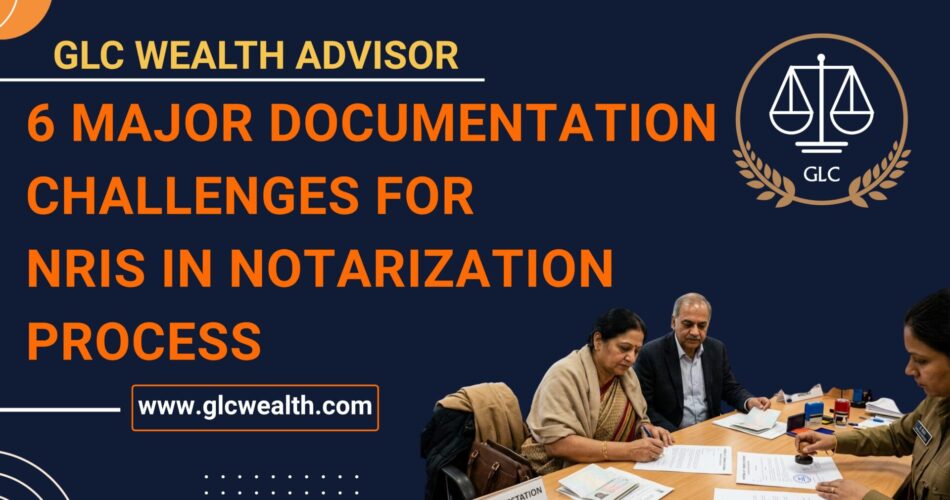
6 Major Documentation Challenges for NRIs in Notarization Process (2026 Guide)
For Non-Resident Indians (NRIs), handling legal and financial matters in India often requires notarized documents. Whether it’s a Power of Attorney (POA), property transaction, or inheritance claim – documentation plays a crucial role.
However, the notarization process for NRIs is often complex, confusing, and time-consuming due to cross-border legal requirements.
In this blog, we break down the 6 biggest documentation challenges NRIs face in notarization – and how to solve them.

1.Confusion Between Notary, Apostille & Attestation
One of the most common problems NRIs face is understanding the difference between:
- Notarization
- Apostille
- Embassy attestation
Many documents require apostille under the Hague Convention, not just a notary stamp.
Solution:
Always confirm the exact requirement based on your document type and use case in India.
2.Difficulty in Getting Documents Notarized Abroad
Notary rules differ across countries, making it difficult for NRIs to:
- Find authorized notaries
- Understand local legal procedures
- Ensure Indian acceptance of documents
Solution:
Use experienced legal advisors or consultants familiar with NRI documentation requirements in India.
3.Rejection of Improperly Notarized Documents
A major issue NRIs face is document rejection in India due to:
- Incorrect format
- Missing stamps or seals
- Improper attestation
Even small errors can delay property or financial transactions.
Solution:
Double-check format, signatures, and certification before submission.
4.Complexities in Power of Attorney (POA)
Creating a Power of Attorney for India involves:
- Drafting correct format
- Notarization abroad
- Attestation / apostille
- Acceptance in India
Any mistake can make the POA invalid.
Solution:
Get POA drafted and verified by professionals before notarization.
5.Legal Differences Across Countries
Each country has its own rules for:
- Notarization validity
- Document certification
- Identity verification
This creates confusion and inconsistency when documents are used in India.
Solution:
Ensure documents comply with both foreign country laws and Indian legal requirements.
6.Delays and High Costs
Notarization for NRIs often involves:
- Multiple steps (notary → apostille → courier)
- High service fees
- Time delays
This can slow down urgent matters like property sale or inheritance claims.
Solution:
Plan in advance and opt for end-to-end documentation support services.
Key Takeaways
- Notarization for NRIs is not just about stamping – it involves multiple legal layers
- Small errors can lead to rejection and delays
- Proper guidance can save time, cost, and stress
Conclusion
The notarization process for NRIs can be challenging, but with the right knowledge and support, it can be managed efficiently.
Understanding these 6 major documentation challenges will help NRIs avoid mistakes and ensure smooth processing of legal and financial matters in India.
Need Expert Help?
At GLC Wealth, we assist NRIs with:
- Documentation & notarization support
- Power of Attorney setup
- Investment & inheritance claims
Get expert guidance and avoid costly mistakes.